
End times
An essay about the apocalypse (or the lack thereof)

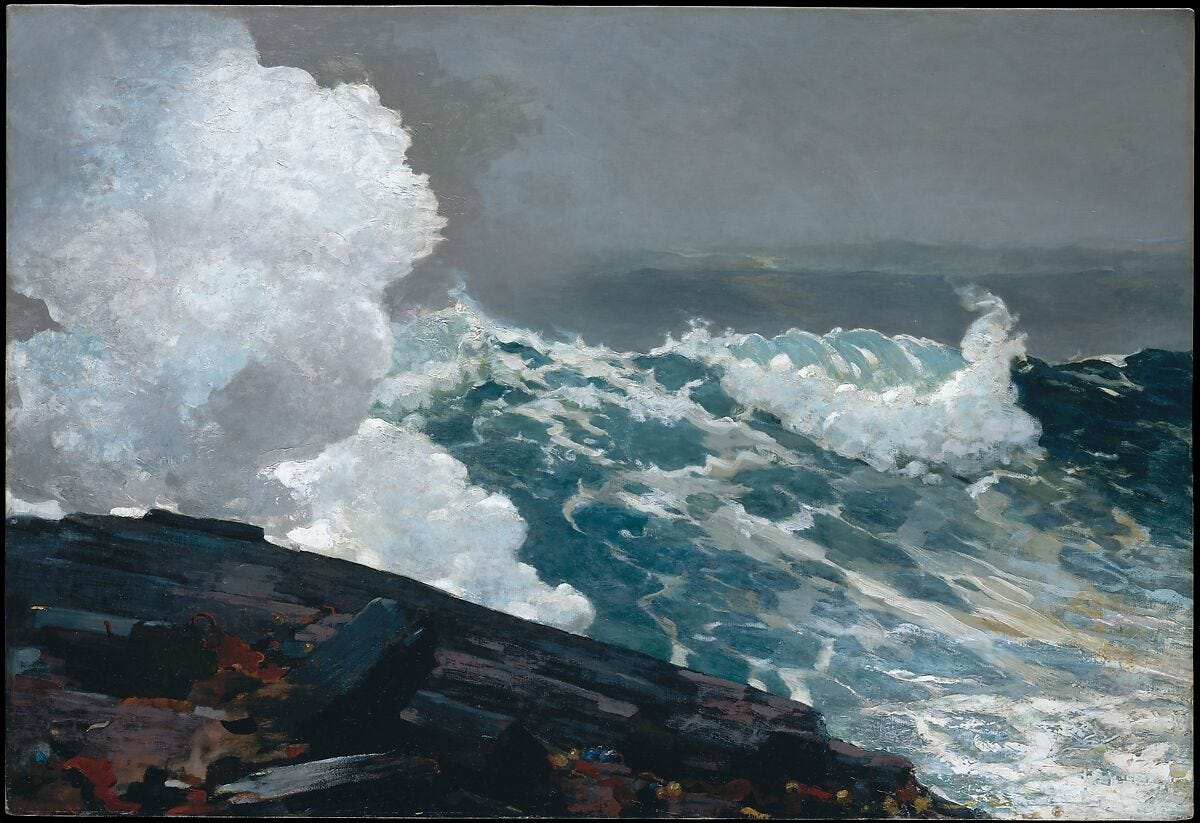
I came up to the sea at Castricum to write, so as to take advantage of living approximately one and a half hours from the grayish-brown expanse that is the North Sea, whose existence in such close proximity, if not its existence at all, tends to escape the memory of us Amsterdam dwellers, and so as to dare the crashing waves to inspire me to write of the end times.
Like all practices that blur the line between the staging of favorable conditions and “brooding writer-performance”, sitting hunched over my laptop at the nautical-themed seaside café didn’t make writing any less arduous, and I seriously began to wonder if there was any use for me being there at all. It’s not like I needed to see a body of water to imagine one, and it’s not like I needed to witness the mightiness of the waves, to imagine mighty waves piling on top of each other until they spilled over the dunes, washing away all separation between coast and chaos. My phone already delivers, at an alarming rate, images of overflowing waters to me. Videos of tides surging into streets, swallowing everything in their path, streams carrying people, cars, multi-story houses with them, rivers meandering between residential buildings, as if fresh springs had welled up, fervent and greedy, from the city drains. Every year the floods are higher, more cataclysmic and more ordinary than the last, and I watch them on screen, my growing desensitization the most disheartening aspect of this looming apocalypse.
Some people would think it preposterous and overly pessimistic to claim that humanity was heading towards a premature Armageddon. I don’t want to discredit them or deny anyone's claim to reason or knowledge of the facts. I simply think that they lack in creativity. It takes an imaginative mind to believe that the world could be submerged under a blanket of water tomorrow, or that the fabric of reality could deflate into something entirely different and unknown. Potentially into nothing.
In spite of the world’s undeniable unraveling, I remain quite fond of the trivial mentions of doom that get thrown around in everyday interactions. Like when my colleague remarked, after the first slight snowfall of the year, that it was “basically the apocalypse out there”. It might seem like she was making light of things. But I actually think it’s important to conflate the consequential and inconsequential sometimes. To collapse the boundaries between the vast and the small, the planetary and the personal, the divine and the profane. Deleuze and Guattari believed that this sort of mental boundary crossing in which the body, the social and the world-historical are blended together, could lead us to some sort of politically empowered magical thinking1. The sort of causal madness in which you imagine that your thoughts and compulsions could prevent a war, in which your organs are inflicted in world history and your actions could cause the apocalypse. But that’s not the only reason I dwell on these apparent dichotomies. Naturally, as a beautiful girl with hobbies and a social life, my thoughts are ridden with Nietzsche. And in particular, the idea Nietzsche waged like a sledgehammer against the entire Western tradition of transcendental philosophy, at the very beginning of Beyond Good and Evil: That a phenomenon could arise from its opposite2. That truth could emerge out of fallacy. And in this case, that all-ending catastrophe could emerge from this ordinary day-to-day life. The apocalypse does feel truly mundane sometimes. Amidst all the unimaginable suffering in the world, you have to wake up, take the metro to work and chat with your colleague about the weather (even on those days when the weather isn’t particularly apocalyptic). The end of the world doesn’t always look or feel like a spectacle. As Elie Wiesel wrote about the horrors of Nazi Germany, “the Apocalypse is a spacious and well-lighted office, well-bred technocrats, efficient secretaries”.3 The end of the world resides in the banality of it all, it thrives on the prosaic and is witnessed by the uninterested. Nowadays, we have to go about our lives while bombs are being dropped on Gaza and Lebanon, while worlds are torn apart on a daily. Our apocalypse, too, is well-lighted offices, it’s stuffy metro rides in the morning, it’s a soft-rock hit faintly oscillating from supermarket speakers. To me, at this moment, it’s a beach on the cusp of the Netherlands and the crowds of suburbanites congregating there.
There are moments when the apocalypse does present itself as a spectacle. In those instances, it becomes a circus of unbridled elements, a chaotic display of the wrath of nature, hellfires and floods, the pyrotechnics of destruction. Simply put: environmental collapse. The increasingly frequent cases of climate change related catastrophes over the last couple of years have shown us that the Reckoning will not fall upon us as one isolated event but as a sequence of disasters that continue to escalate in severity. As Susan Sontag wrote, it’s “not ‘Apocalypse Now’, but Apocalypse From Now On”.4 The end of the world is not the final confrontation to be overcome at the end of a hero’s journey, but rather, the prevailing condition of our present era. It’s the prelude to our eventual demise.
As unthinkable as it is, sitting here watching the waves, feeling fortunate because the ocean hasn’t decided to reclaim this country yet, there were times in history when people were pining for the Deluge. Scientific progress in the 17th century, and in particular insights gained in the field of physics, roused doubts about the likelihood of a biblical apocalypse.5 The predominant end times mythology of divine destruction didn’t hold against the finding that it wasn’t in fact God’s will directing all movement in the universe but the laws of motion. The idea of final retaliation enacted by a spiteful creator seemed silly against the understanding of earth as only a small spec in the cosmos. But instead of finding solace in this knowledge, people were terrified to find their worldview crumbling. After all, it promised that justice will be served and that heaven on earth will be administered for the righteous. To soothe these anxieties, many thinkers hoped to prove that modern science was still compatible with the broad annihilation of everything. One such thinker, the theologian Thomas Burnet, took it upon himself to calculate the amount of water in the world and published in 1681, his unfortunate realization that there wasn’t enough of it to be found in all the clouds, rivers, and seas combined, to drown the entire globe. Another, William Whiston, delivered the good news in the 1710s, that his research proved it probable that the planet will be destroyed by the impact of a comet hitting its surface, bringing about, if through different means than expected, its promised end.
Not everyone who longs for the end of things is wrapped up in the self-righteous fantasy of evil forces succumbing to their God on Judgment day. The Prussian general Ferdinand von Schill, who fought against the takeover of Napoleonic France, is one of the first people reported to have uttered the German saying “besser ein Ende mit Schrecken, als ein Schrecken ohne Ende” - better an end with terrors, than terrors without end. Much like the pre-enlightenment scholarship of God-fearing scientists, the saying depicts the world as depraved and decrepit. Wanting to overcome this, it welcomes the violence the apocalypse necessarily entails. But while one outlook seeks redemption, the other is humbly requesting release from worldly suffering. When Von Schill did find his end in 1809 at the Battle von Stralsund, he left behind a complicated legacy. Monuments erected to commemorate him, an infantry division of the Wehrmacht named after him, and an apocalyptic outlook that imagines the end of the world not as a triumph for the righteous but as the killing of an ailing horse.
I, for one, am not expecting salvation, but I’m not keen on being mercy-killed either. Reasons for craving the apocalypse are numerous and often enough, more affiliated with a desire for atonement, than for any kind of reward or relief. For the sinner hoping to do penance, anything can and will be seen as a malign omen. Take New England's Dark Day in 1780, when the sky was overcome with a combination of smoke, fog and thick clouds in the middle of the day, creating such an impenetrable cover that large parts of the Northeastern United States were subdued by complete darkness. It’s no surprise that onlookers thought that they were witnessing the final judgment of the heavens. People didn’t have constant access to information like we do today, no search engines or Twitter threads to lend plausible interpretation to otherwise inexplicable anomalies. And yet, apocalyptic fears thrive just as much in the presence of our abundant information network. Sometimes even because of it. In the late 1990s, the general public, government leaders and IT industry experts were counting the days to a computer-induced civilizational meltdown. It was forecast that digital systems would fail to operate when the two-digit year abbreviations that were commonplace in programming, changed into the double-zero of the new millennium, leading to the malfunctioning of everything from financial systems to power grids. Y2K was distinct from any popular doomsday scenario that came before it. Suddenly the end of the world wasn’t written in the stars, but encoded in digital voids. It wasn’t directed by fate or destiny, but driven by error. It was the misrepresentation of a numerical value, a mishap that turned this milestone timestamp of modernity into the absence of value. This date, zero-zero, resembles the genesis of our calendar 2000 years ago but is indistinguishable from the empty space that will follow after time and calendars have ceased. It’s the end of the world by deletion, a glitch to turn us into nothing. It’s no wonder that this occasion and its threat of nothingness would speak so much to the subliminal desire for apocalypse that lies dormant in all of us. “Many seemed to take pleasure in frightening themselves to death over a coming calamity” commented Dennis Dutton in his Y2K-retrospect, It’s Always the End of the World as We Know It6. Y2K showed us that the end of the world as a cultural trope often says less about the real presence of existential threats than it does about our desire to reckon with a world that has gone awry, and more often than not, it exposes the wish to atone for perceived wrongdoings. A 1999 article by Vanity Fair reproached that it was “folly, greed, and denial” that led to the Y2K fiasco7, essentially framing the tech apocalypse as just punishment for human hubris and reckless reliance on machines. Similarly, the poet John Greenleaf Whittier wrote about the darkest day of the American Northeast that “the dreadful face of Christ” peaked out of “the black sky”. Not loving as usual, “but stern. As Justice and inexorable Law.”8
Atonement is a trade-off. You have to suffer to be redeemed and only get to win as much as you lose. No one understood this like Dostoevsky did. He nearly made Raskolnikov lose his sanity to pay for his misdeeds. In Crime and Punishment, this character’s internal conflict between damnation and redemption is frequently symbolized through water, with the Neva River and the canals of St. Petersburg appearing at times as oases of hope and tranquility, at others as the sediment of the city’s filth. In a key moment of the novel, the cold depths are almost used as the hiding place for a murder weapon, at another, they serve as the backdrop for the confession of crimes. The moral crisis Raskolnikov goes through, his mental torture and suffering are themes that can be found all over Dostoevsky’s literary corpus. His work represents the depravity, desolation and abject misery he observed in his contemporaries, expertly crafting what Nikolai Berdyaev once described as a distinct “atmosphere of apocalypse.”9 But in his texts, suffering is not exceptional. It’s a basic fact of the human condition, our biggest vice and raison d’être. In Notes from the Underground, the protagonist ponders that humans were “extraordinarily, passionately, in love with suffering” and that it was ”the sole origin of consciousness”.10 More than that, it’s humanity's only chance for salvation in this life of sin. A stream to wash you clean, a river to drown in.
In The Science of Last Things Ellen Wayland-Smith muses how a look back on geochemical deep time instills a sense of “radical humility” in those who study it. “To be low to the ground, on par with the earth’s crust, subject to the same cyclical processes of roiling, cooling, ribboning, crumbling, rise and fall and rise again.”11 It puts our existence into perspective, turning, as she describes, geologists into philosophers. The study of literature and history has a similar effect. The world was dying when Dostoevsky was writing his masterpieces, just as it was when noxious clouds of volcanic eruption caused the Late Permian extinction. Now, as the world has turned misty, nebulous and suffocating again, I remind myself that this time period isn’t unique. I found that chronocentrism, the fallacy by which people assume that their experiences are totally unprecedented and exceptional, is experienced the strongest when our emotions are the heaviest and purest. Like in love or despair. This self-absorbed myopia can be useful and lend gravity to our experiences. It’s what leads you to believe, when you find yourself in love for the first time and feeling butterflies in your stomach, that you must be the first person to ever discover this new height of sensation. In turn, when living through times of widespread societal entropy, it drives the perception of having strayed further and lower than any generation that came before.
I often think about how Francis Fukuyama declared the end of history in the 1990s. Following a century of grand ideological battles, Fukuyama believed that the world had finally achieved equilibrium in liberal democracy. Much like the Pax Romana had once been viewed as the final age of humanity, Western hegemony was to him, the absolute destiny of the world. Fukuyama considered it inevitable that political liberalism would follow economic liberalism, or in other words, that a general embracement of equity and the rights and liberty of the individual, would be the natural consequence of capitalism. Of course, history, which isn’t over yet, has already proved him wrong, as we know today that capitalism can sustain itself just as well under rising fascism. End of history theory reads like a dull blend of American exceptionalism, Hegelian dialectics and the childlike wonder you possess before grasping that you exist in the throes of history. It matches Hegel in his penchant for apocalypticism, building an argument on the idea that all of humanity’s struggles are part of the continuous progression toward the truest and most ideal way of being. Both are subscribing to a linear view of time, in which all of history climaxes in a revelatory finale. Nevertheless, I can’t decide whether the end of history can be at all equated to the end of the world, or if they are instead diametrically opposed to one in another. One of them being the end times, the other an uneventful expanse of time.
Reading his infamous paper, it dawned on me that Francis Fukuyama must have thought, when he was in love for the first time, that he was the first person ever endowed with the ability to experience so intensely and so beautifully.
It’s clear from all of this, that there is a general inclination in people to understand their place in the world by temporally positioning themselves at the end of things. In The Sense of an Ending Frank Kermode points out that people use fictions following the narrative structure of beginnings and endings to make sense of eternity12. Just as the biblical canon lays out the entire timeline of the universe in a story starting from Genesis and concluding in the Book of Revelation, we want to be part of a coherent story whose ending will justify all that came before it. And so we conceptualize ourselves as the last people living in an era of decay, a civilization on the verge of succumbing to the rot. Recognizing that people have prophesied time and time again that the end of the world was near, Kermode proposes the hypothesis that the end isn’t in fact imminent but instead immanent. Which is to say that death isn’t knocking on humanity’s door yet, but that apocalyptic thinking is intrinsic to our cultural lens and consciousness. The alternative, he explains, would be to accept that the history of the world is long and aimless, with stretches of time spanning before us and after us, placing our existence, short-lived and weightless, in the insignificant middle of things.
Therein lies the error of common apocalypticism. In the belief that time progresses with inherent intent, and at that, with the intent to cease. The English language reflects this, as “an end” is just another way to speak of purpose. But if you’re wondering to which end we exist, then it’s certainly not to perish but to be. The universe doesn’t care to gratify the human need for conclusions, nor for a linear order of things. Moments don’t stack up on top of each other until the shaky tower of hours, years and eons collapses in on itself. The end times certainly won’t be the end of time. Nowhere in our cultural canon is this written out as clearly as in post-apocalyptic fiction, a literary genre that refuses to impose dialectic idealism on the disorder of being. Octavia Butler’s seminal work Parable of the Sower is one of the most striking examples of this. It tells the story of a group of people trying to carve out a future for humanity from the lawless ruins of the United States of America. While this novel meditates on what remains of civilization after the apocalypse, it really describes a heightened version of everything that feels apocalyptic about the present - most notably climate change, social injustice and wealth inequality. Written in the 1980s, the events of this science fiction tale coincidentally take off in the very year I am writing these words, in 2024. And while we are not quite at the stage yet, in which people have to live as indentured workers in company towns to escape the ruthless wasteland the world has turned into, Butler is not too far off. Many of the plotlines read like prophecies in hindsight (take for instance the zealot president promising to “make America great again”). But it’s more than just a speculative gaze into the future. The past reverberates just as loudly in this story. In the sequel, Parable of the Talents, society continues to deteriorate, leading to the resurfacing of brutal oppressions of previous centuries, subjecting the characters to high-tech chattel slavery and militant attacks by Christian crusaders. Past, present, and future all fuse into a single dystopia. Which raises the question if the apocalypse is really something we’re heading toward or rather that we’re regressing into. The latter aligns with the outlook that history isn’t advancing towards an end goal but is instead moving in a cyclical manner, ever evolving, deteriorating and repeating. Just like apocalyptic fears have appeared time and time again throughout history, the cruelties we inflict on each other come and go. Human suffering, at all times, is as much informed by memory as by possibility.
I’m having a new hunch about the apocalypse. I no longer believe that it has much to do with floods, with their cleansing power and vast biblical scope. It’s nothing like a river either, which runs linear and purposefully. Instead, it's like the tides - here and then gone again.
Far from being fatalistic, Parable of the Sower is a tale about resilience. It reframes the apocalypse, from a world-ending event to a transformative one. Change is the main thematic thread of this narrative and more than that, it’s an ethos and becomes, quite literally, a religion. Throughout the story, the protagonist, Lauren Oya Olamina, creates a belief system around the principle that change is the only constant in the universe. Many of the lessons she preaches are drawn from her experience of living in the state-of-nature-redux of a former global empire. And she endows these experiences with deeper meanings, on the universe and the divine. “God is Change”, she writes “From one, many; from many, one; Forever uniting, growing, dissolving — forever Changing. The universe is God's self-portrait.”13 Her gospel speaks on the very nature of reality. On the way that every being, mineral and atom is perpetually digested by the cosmos, which breaks us down, dissipates us and transforms us into new iterations of life and matter. Every change, good or bad, is part of this eternal interplay of stars, breath and dust. The apocalypse, in this conception, is nothing but another face of change. Another face of God.
And yet, despite knowing myself to be a person who is both hopeful and partial to beauty over truth, I have my gripes about this. Not because I doubt that celestial ego death and decomposition await us all. But because I disagree with the suggestions that this world is redeemed, simply for blossoming in the likeness of a deity. Nietzsche argued that the entire tradition of metaphysics, starting with Plato and Socratic philosophy, was based on the assumption that the higher things of the spirit cannot spring from a world that is mundane, cruel and human. A thing cannot emerge from its opposite. That’s why love, beauty and divinity must come to us from a higher plane, and that’s why it’s the job of the philosophers to discover the objective tenants of goodness and morality that exist independently and far removed from humanity. This also means that humanity, damned as it is, cannot be redeemed, at least not by itself. Redemption must come from this other sphere, from behind the veil of human perception, from God, from the ether. Nietzsche fundamentally rejected this idea - and not because of his negation of God or alleged proximity to nihilism. Contrary to popular belief, it was never Nietzsche’s project to kill God. He instead found him, already dead, and from this starting point, from the absence of God and meaning, sought to develop a yes-saying philosophy that doesn’t affirm life through its inevitable demise, but from within itself. Because we are thrown into this godless and abandoned world, yet live with our eyes wide open and find what we see meaningful. Isn’t it life-denying then, to insist that true beauty and divinity aren’t part of this world? That they will only be revealed when the shell of our existence is broken down because we have arrived at the afterlife or the apocalypse? As if divinity only existed where life and the world have ceased and as if every conception we have of goodness didn’t come from this realm. So you should receive this knowledge with joy and gratitude, that we will truly not be saved. As Camus once said, “The world is beautiful and outside there is no salvation”.14
In German, we say Weltuntergang to speak of the end of the world. It’s a compound word made from Welt, meaning world and Untergang, meaning a bunch of things. Untergang can translate to doom or demise, but could also refer, rather neutrally, to the downward movement of things. Nietzsche made use of this linguistic ambiguity repeatedly in his novel Thus spoke Zarathustra. Every time the sojourn of the prophet down from his mountaintop is described, Nietzsche leaves it to the reader to decide what he really means. “Thus began Zarathustra’s descent”15, might just as well be “Thus began Zarathustra’s doom”. Untergang can also refer to the movement of celestial bodies in our sky, in particular that of the sun. So you can say Sonnenuntergang, and that is the sunset.
I’m wondering if the Untergang of the world, its demise and eventual ruin, might be like that of the sun behind the horizon. Not a singular all-ending event, but a normal movement in the dance of the cosmos. Planets falling and rising in each other's orbit, life becoming embodied and then dust again. I’m not making these comparisons for the sake of poetry: the apocalypse as the tides, the apocalypse as the setting sun. I’m just drawing these connections to point out that we are in the middle of ever-repeating cycles of nature. There is the cyclical movement of oxygen through the atmosphere, living breathing bodies and the earth’s crust. There is the coming and going of the seasons, the water cycle, the cycles of the menstruating body and the moon. And then of course, there is time itself, which Nietzsche believed to be forever recurring. “The eternal hourglass of existence is turned upside down again and again, and you with it, speck of dust!'16
Although we have reason to believe that it won’t be tomorrow, it’s safe to say that the world will end at some point. Then, only eternity will be left, and every moment you ever lived will stand as part of it. It’s a shame that humans are shaping this endlessness in such a displeasing way. The apocalypse, when it finally does arrive, will at the very least be every bit as awful as the present — and that says a lot! But even then, the world will surely find ways to remind us that it is and was beautiful. Existence is a mixed bag. So is eternal recurrence. It’s why the death of this ephemeral place repeats endlessly forever. It’s also why I return, again and again, to the ocean.
Gilles Deleuze, Félix Guattari (1972) Anti-Oedipus: Capitalism and Schizophrenia
Friedrich Nietzsche (1886) Beyond Good and Evil
Elie Wiesel (1984) Visions of the Apocalypse
Susan Sontag (1978) Illness as Metaphor and AIDS and Its Metaphors
Perry Miller (1951) The End of the World
Dennis Sutton (2009) It’s Always the End of the World as We Know It
Robert Sam Anson (1999) 12.31.99 The Y2K Nightmare
John Greenleaf Whittier Abraham Davenport
Nikolai Berdyaev (1923) Dostoevsky
Fyodor Dostoevsky (1864) Notes from Underground
Ellen Wayland-Smith (2024) The Science of Last Things
Frank Kermode (1967) The Sense of an Ending
Octavia Butler (1993) Parable of the Sower
Albert Camus (1938) Nuptials
Friedrich Nietzsche (1883) Thus Spoke Zarathustra
Friedrich Nietzsche (1882) The Gay Science
Love disss!!! Been a while since I've read your stuff🫵🏿
Thank you for this!